 blog
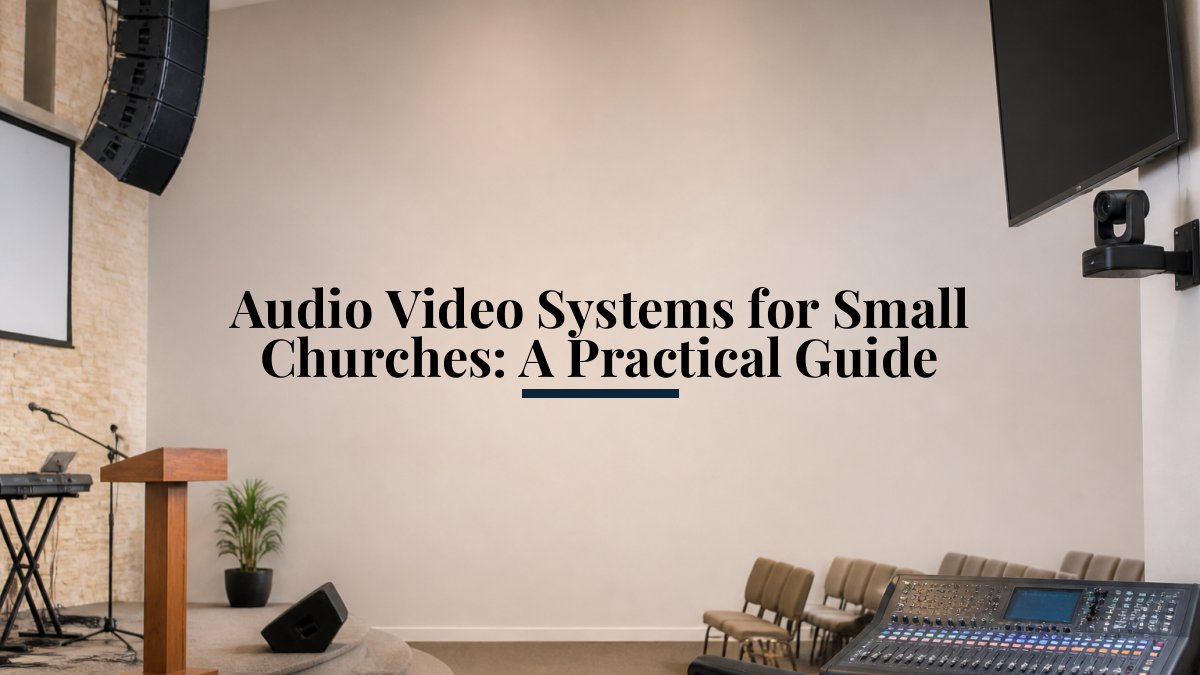
Audio Video Systems for Small Churches: A Practical Guide
Last Updated: November 3, 2026
Quick Summary
Audio video systems for small churches should be designed around your room, seating, and volunteers rather than bought as a shopping list. Start with clear speech, then phase in wireless mics, acoustic treatment, and streaming as budget allows. A modest, well-planned system beats a large, poorly-matched one nearly every time.
- Mount two speakers at the front, angled inward and aimed at the back rows.
- A 12- to 16-channel digital mixer with saved presets suits volunteer-run churches.
- Basic tier equipment plans roughly $1,500-$3,500 for rooms under about 150 seats.
- Build a separate stream mix so the pastor's voice stays forward online.
- Put audio gear on a dedicated circuit with a surge protector.
Table of Contents
- Audio Video Systems for Small Churches: Where to Start
- Choosing the Best Sound System for a Small Church
- Wireless Church Sound Systems and Mixer Options
- Room Acoustics and Sound Tuning
- What Does a Sound System for Church Price Out At?
- Church Live Streaming Equipment and Video Basics
- Wiring, Power, and Network Requirements
- Planning Your Church AV Installation with NewDay Tech
- Frequently Asked Questions
Audio Video Systems for Small Churches: Where to Start
Audio video systems for small churches do not need to be expensive, but they do need to be designed around your room, your seating, and the volunteers who will run them every Sunday.
Start with three questions before you shop for a single piece of gear:
- How many people does the room seat on a typical Sunday?
- Who runs the system, and how much training will they realistically get?
- Do you need to stream the service, record it, or only reinforce live sound?
Your answers set the budget, the complexity, and the equipment list. Get them wrong and you will buy gear that fights your room and confuses your volunteers.
Audio video systems for a small church usually fall into three tiers: a basic speech-and-music setup, a mid-tier system with wireless mics and a digital mixer, and a full package with streaming and video. Below, we walk through each component and how to phase the work so a tight budget still produces a clean, reliable result.
Choosing the Best Sound System for a Small Church
The best sound system for a small church prioritizes clear speech over sheer volume. Congregants need to understand the pastor, hear the singers, and follow along without straining. That means coverage and intelligibility come first, and loudness comes last.
Speakers and Placement
Speaker placement does more for sound quality than speaker price. In a small worship space, mount two speakers at the front, angled slightly inward and aimed at the back rows rather than the front pews. Sound drops off with distance, so aiming at the rear keeps the whole room even.
Avoid placing speakers behind the pastor or directly overhead. Both cause feedback and make speech harder to follow. A common mistake is buying one large speaker and pointing it down the center aisle; two smaller speakers spread wider almost always sound better in a room under a few hundred seats.
Microphones for Pastors, Singers, and Instruments
Match the microphone to the job. A pastor who walks the stage needs a wireless lavalier or headset so hands stay free and the level stays constant. Singers do better with handheld wireless mics, and instruments can share a couple of well-placed mics rather than one per player.
Wireless microphones remove cable clutter and let speakers move naturally, which matters in a worship space with a raised platform. Choose a system with enough channels for the pastor plus two or three vocalists, and keep a spare channel open for guest speakers.
Wireless Church Sound Systems and Mixer Options
Wireless church sound systems combine the microphones, receivers, and mixer into one coordinated setup. The mixer is where most small churches either save money wisely or waste it.
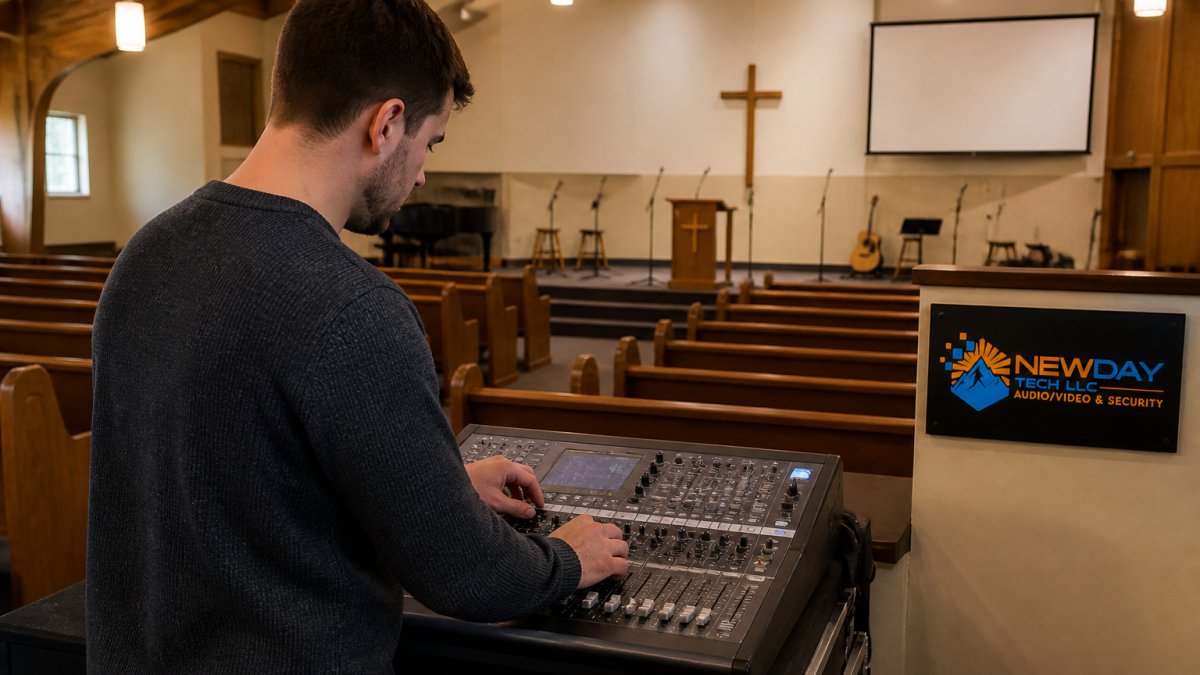
For a volunteer-run church, a digital mixer with saved presets is worth the investment. Volunteers recall a scene by name ("Sunday service," "funeral," "youth night") instead of rebuilding settings from scratch. Analog mixers cost less up front but demand more skill every week.
A practical rule: if your volunteers change week to week, buy the simplest mixer that still covers your channels. A 12- to 16-channel digital mixer handles a pastor, several vocalists, and a couple of instruments with room to grow. Label every channel and tape a one-page cheat sheet to the desk.
Watch out: buying a mixer with far more channels than you use adds confusion, not capability. Volunteers freeze when faced with dozens of unused faders.
Room Acoustics and Sound Tuning
Room acoustics decide how much of your equipment budget actually reaches the congregation. Hard surfaces like tile, glass, and bare drywall bounce sound and create echo, which smears speech and invites feedback.
Simple acoustic treatment goes a long way. Heavy curtains, carpet, upholstered pew cushions, and acoustic panels on the rear wall reduce reflections. You do not need a recording studio; you need to tame the worst slap-back so the pastor's words stay crisp.
After treatment, tune the system. Set levels with the room full of people, not empty, because bodies absorb sound. Walk the room during a rehearsal and listen at the back row, the sides, and the front. For a deeper look at speaker placement and acoustic treatment, see our guide to integrated sound systems for large venues, which covers the same principles in more detail.
What Does a Sound System for Church Price Out At?
A sound system for church price depends on room size, channel count, and whether you add video and streaming. Rather than quote a single number, it helps to think in tiers, because pricing depends on room size, equipment selection, and installation requirements.
| Tier | Typical Scope | Planning Range (Equipment) | Who It Suits |
|---|---|---|---|
| Basic | Two powered speakers, stands or mounts, a 12-channel analog mixer, two wired mics, cabling | Roughly $1,500-$3,500 | Rooms under about 150 seats, speech-focused services |
| Mid | Four powered speakers, a 16-channel digital mixer with presets, two wireless handhelds plus a lavalier, basic acoustic panels | Roughly $4,000-$9,000 | Growing congregations with a worship band |
| Full | Mid tier plus a PTZ camera, display or projector, streaming computer, and network switch | Roughly $9,000-$20,000+ | Churches streaming or recording weekly |
Installation, cable runs, mounting, and labor are separate from equipment and depend on the specifics of your room. Ask every bidder to separate gear, labor, and cabling on the quote.
Total cost of ownership matters as much as the purchase price. Budget for consumables and wear items such as microphone batteries, replacement cables, and spare wireless capsules, and plan for ongoing support.
Phasing is how tight budgets survive. Start with sound, speakers, mixer, and mics, because clear speech is the foundation everything else builds on. Add wireless channels and acoustic treatment in year two, then video and streaming once the audio is stable and volunteers are comfortable.
Watch out: two bids that look similar often cover very different work. Get a written scope that lists every component, every cable run, and whether training and a follow-up visit are included before you compare totals. For current pricing, check the NewDay Tech pricing page or request a quote.
Church Live Streaming Equipment and Video Basics
Church live streaming equipment turns a live service into something shut-ins, travelers, and families can join from home. The goal is not broadcast-studio polish; it is clear audio, a steady picture, and a stream that does not drop.
Audio quality matters more than video quality in a stream. Viewers forgive a soft image but abandon a stream they cannot hear.
Latency is the other audio issue. Wireless microphones, digital mixers, and streaming software each add a small delay, and when they stack up the pastor's lips and voice drift apart on screen.
Internet reliability decides whether any of this works. A wired connection from the streaming computer to the router beats Wi-Fi every time.
Cameras, Displays, and Projectors
For video, a single PTZ camera mounted at the back of the room covers most small-church needs. PTZ cameras pan, tilt, and zoom remotely, so one volunteer can follow the speaker without a second operator. Mount it high enough to see over the congregation and frame the platform, and set a couple of preset shots, wide for worship, tighter for the sermon, so the volunteer taps a preset instead of steering manually.
Displays and projectors serve the room, not the stream. A projector and screen handle lyrics and scripture for most sanctuaries; a large display works better in bright rooms where projection washes out. Match screen size to the farthest seat, and keep lyrics large enough to read from the back row.
If you are building a streaming setup from scratch, our guide to live streaming equipment for small congregations walks through affordable cameras, audio gear, and software for tight budgets.
Wiring, Power, and Network Requirements
Wiring and power are where small-church AV projects quietly fail. Plan cable runs before installation, keep audio cables away from power lines to avoid hum, and label both ends of every cable.
Network matters the moment you add streaming or wireless control. Give the AV system its own network switch or VLAN so streaming traffic does not compete with office Wi-Fi. A wired connection from the streaming computer to the router is more reliable than Wi-Fi every time.
Power deserves its own circuit. Put the audio gear on a dedicated circuit with a surge protector, and avoid sharing it with kitchen or HVAC equipment that causes voltage dips. Reliable power protects both the equipment and the service.
Planning Your Church AV Installation with NewDay Tech
A successful install starts with a plan, not a shopping list. We begin by walking the room, measuring coverage, and asking how your volunteers actually run a service. From there we design a system sized to your space and budget, then install it and train the people who will use it.
We manage the project from initial planning to ongoing support, so you are not left juggling multiple contractors. You can see the full range of technology services that work better together on our services page.
Small churches with tight budgets are among the organizations we work with. To learn more about our team and request a consultation, visit our local technology support page.
If you are ready to stop guessing and get a system built for your room, explore our AV system design guide for small churches to see how audio, video, lighting, and budgeting fit together.
Frequently Asked Questions
What is the best sound system for a small church?
There is no single best system, but a practical setup for most small sanctuaries includes two powered speakers on stands or wall mounts, a digital mixer with simple presets, and a mix of wired and wireless microphones. Match speaker coverage to your seating capacity and room shape. A local integrator can tune the system to your acoustics so volunteers get consistent results every service.
How much does a sound system for a church cost?
Cost depends on room size, channel count, and whether you need wireless microphones or streaming gear. A basic speech-focused setup costs far less than a full band and livestream package. Pricing for NewDay Tech's audio video systems depends on your specific space and requirements, so check their website or request a quote for current figures rather than relying on generic estimates.
Can one AV system handle both in-person worship and livestreaming?
Yes. A single digital mixer can feed your in-room speakers and send a separate mix to your streaming encoder at the same time. The key is planning signal flow up front: dedicate an aux or matrix output for the stream, add a PTZ camera and capture device, and make sure your network upload speed can handle the bitrate. This avoids running two separate systems.
What equipment does a small church need for live streaming?
At minimum you need a camera (a PTZ camera works well for volunteers), a capture card or encoder, a computer or streaming device, and a wired network connection. Audio matters more than video quality, so route a clean feed from your mixer rather than relying on camera microphones. A video switcher and simple lighting help once you stream regularly.
Every small church deserves a system that lets the congregation hear clearly and the volunteers run Sunday without stress. If your current setup crackles, feeds back, or confuses whoever is at the mixer, NewDay Tech can help. We design and install AV systems sized to your room, integrate them with your network and security, and provide ongoing support so the technology stays simple. Get started with NewDay Tech and request a consultation to plan a system that fits your space and your budget.