 how-to
Hiring Local Tech Integration Specialists: A Practical Guide
Table of Contents
- What Technology Integration Specialists Actually Do
- Identifying Your Technology Integration Project Planning Needs
- Where to Find and Vet Local Tech Integration Services
- Whole-Property Wi-Fi Installation and System Architecture
- Interview Questions and Practical Skills Assessment
- Hiring Costs, Engagement Models, and What to Expect
- Security, Compatibility, and Post-Launch Support
- Frequently Asked Questions
Last Updated: October 18, 2026
What Technology Integration Specialists Actually Do
Tech integration specialists design, install, and manage interconnected systems that work together across your property. Unlike a general IT technician who troubleshoots individual devices, a tech integration specialist thinks in whole-system architecture, planning which systems should communicate, configuring them, and training you to use them as one unified platform.
The role spans hardware, software, networking, and security.
This is especially critical on rural properties where standard solutions fail: trees block line-of-sight to cell towers, barns and metal structures interfere with wireless signals, and long distances mean ethernet runs of 300+ feet.
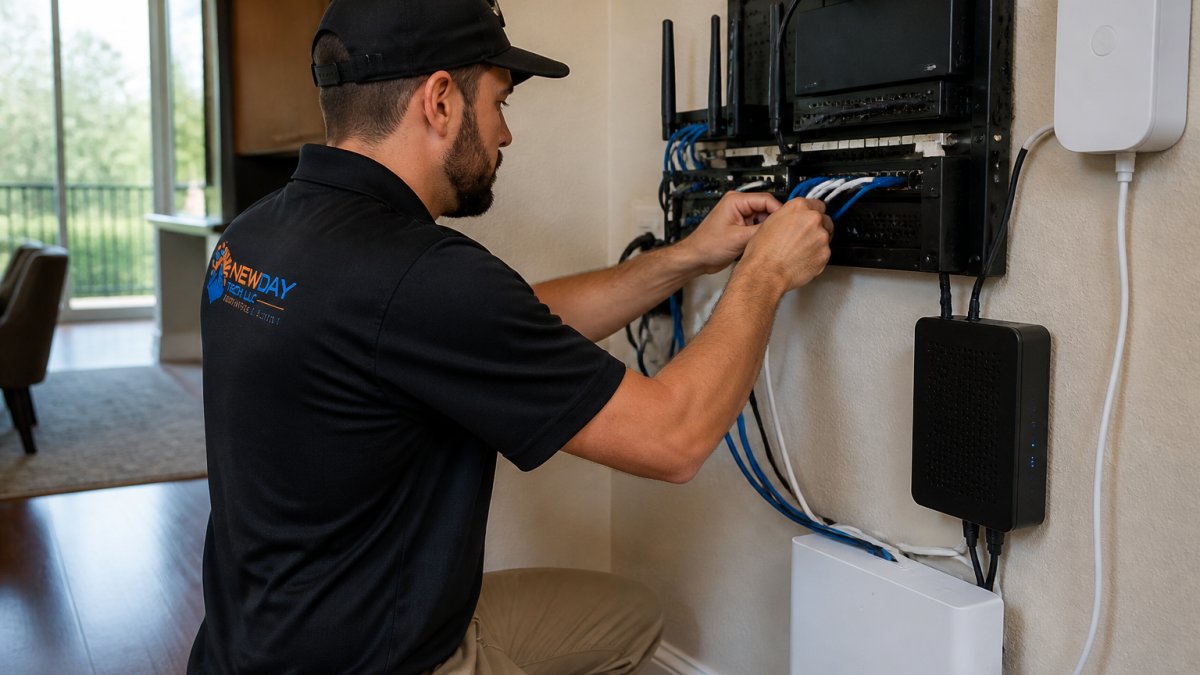
NewDay Tech approaches this as a full-cycle service: the team designs the system around your property layout, manages installation, tests everything end-to-end, documents how it works, trains you, and provides ongoing support. That continuity matters because integration problems often surface weeks or months after installation.
Identifying Your Technology Integration Project Planning Needs
Before you contact tech integration specialists, clarify what you're trying to solve. Integration projects fail most often because scope wasn't defined upfront, leaving you with a system that solves half your problems and creates new ones.
Start by listing every connected device and system you have or plan to add: cameras from different manufacturers, Wi-Fi routers in different buildings, an alarm system that doesn't talk to the cameras, a Starlink dish separate from your wired network, audio equipment with no integration.
Next, write down what you need these systems to do. Can you monitor security cameras from your phone when you're away? Arm the alarm remotely? Manage all your Wi-Fi networks from one dashboard? Does your system need redundancy if the main internet fails?
Scope and Specialist Types
Scope varies widely: a small residential Wi-Fi installation might be a weekend project, while a full ranch integration covering security, Starlink, network infrastructure, and audio could take weeks and multiple specialists.
Scope determines which specialist you need. A Wi-Fi specialist focuses on coverage and performance; a security systems integrator handles cameras, alarms, and monitoring; a Starlink technician specializes in satellite installation and positioning.
Small projects, Wi-Fi in one barn, cameras in a specific area, can often be handled by a single technician. Large projects benefit from a project manager who coordinates multiple specialists and ensures all the pieces work together.
Common Integration Challenges on Rural and Remote Properties
Rural properties face integration challenges urban installers often underestimate. Starlink requires clear sky visibility, so the dish often sits far from where you want your internet.
Wi-Fi across multiple buildings requires careful antenna placement and often mesh networking. A single router in your main house won't reach the barn 200 feet away, and trees weaken the signal further.
Legacy systems compound the problem: cameras from three manufacturers each with its own app, an older alarm system that doesn't integrate with modern technology, audio equipment that predates wireless standards. A tech integration specialist's job is to make these disparate systems work together, or recommend replacements where integration isn't possible.
Where to Find and Vet Local Tech Integration Services
Finding a qualified tech integration specialist requires more than a Google search. You want someone with hands-on experience in your area, not a national chain that sends whoever is available.
Start with local recommendations: ask neighbors with similar properties, your internet service provider, and local contractors, electricians, builders, and security companies who work regularly with technology specialists. These sources know who does good work and who leaves problems behind.
Online reviews matter, but read them carefully. Look for reviews mentioning rural properties, outdoor installations, or multi-system integration.
Local Hiring Channels and Geographic Verification
Local hiring channels filter out specialists who aren't actually local. Craigslist, local Facebook groups, and community bulletin boards attract people who work in your area, while national job boards may show you someone in another state who has never worked on a property like yours.
Verify geography explicitly: ask where they're based, their service area, and for references from similar properties in your region.
A tech integration specialist who knows your local environment, internet options, terrain, weather patterns, and local contractors has a massive advantage over someone parachuting in from elsewhere. They know which equipment works in your climate and which local electricians are reliable.
Red Flags and Credentials to Check
Watch for specialists who rush the planning phase. Good integration work requires understanding your property, current systems, and actual needs before anyone orders equipment. A quote given without visiting the property or asking detailed questions isn't integration thinking.
Red flags include vague proposals, no timeline, no explanation of how systems will integrate, and no mention of testing and training after installation.
Credentials matter, but not as you might expect. Certifications exist for specific systems, Starlink installer certifications, security training programs, networking vendor certifications, but the most important credential is experience.
Check whether they carry professional liability insurance, and actually call their references. Ask whether the specialist was responsive after installation, whether the system worked as promised, and whether they'd hire them again.
Whole-Property Wi-Fi Installation and System Architecture
Whole-property Wi-Fi requires architecture, not just equipment. No single router can reliably cover multiple buildings separated by distance and obstacles; the solution involves mesh networking, strategic access point placement, and often a mix of wired and wireless connections.
A tech integration specialist designs the network around your property's layout: where ethernet cabling can create wired connections between access points, where wireless repeaters are needed, which areas need outdoor coverage, and what your expected usage is.
The architecture includes redundancy. If your main internet connection fails, a backup, cellular data or a second internet service for Starlink-dependent properties, keeps you online. The specialist configures the network to switch automatically without dropping your connection.
Security is part of architecture. A tech integration specialist configures your Wi-Fi with strong encryption, separates guest networks from your main network, and ensures that security cameras and other devices are on isolated networks that can't be compromised through your personal devices.
Interview Questions and Practical Skills Assessment
Before hiring, interview multiple candidates. Ask questions that reveal whether they think in terms of integration or just individual installations.
Technical Questions That Reveal Real Expertise
Ask how they would handle a specific scenario on your property. For example: "I have Starlink in one building and need reliable Wi-Fi in another building 300 feet away, with trees between them.
A good answer includes specifics: mesh networking, outdoor access points, possibly ethernet runs through conduit, signal strength testing, and contingency plans if trees grow or weather impacts performance.
Ask about their approach to system integration. If you have existing cameras and an alarm system, how do they integrate those with new equipment? Can they pull video from multiple camera brands into one dashboard?
Ask about testing and troubleshooting. How do they verify that a system actually works before they leave? What tools do they use to test signal strength, latency, and reliability? How do they identify integration problems?
Evaluating Problem-Solving and Communication
Ask a hypothetical problem: "After installation, you discover that the security cameras lose connection during heavy rain. What do you do?" A good answer involves diagnostics, is it the antenna position, the cable quality, the equipment itself?
Pay attention to how they explain technical concepts. A tech integration specialist should be able to explain what they're doing in terms you understand, not hide behind jargon. If they can't explain it clearly, they probably don't understand it deeply.
Ask about their communication process during a project. How often do they update you? How do you reach them if something goes wrong? What happens if the project takes longer than expected? Their answers reveal whether they treat communication as part of the job or an afterthought.
Hiring Costs, Engagement Models, and What to Expect
Technology integration projects have different cost structures. Some specialists charge hourly rates. Others charge per project. Some offer maintenance plans. Understanding the model matters because it affects your total cost and your relationship with the specialist.
Project-Based vs. Ongoing Support Arrangements
Project-based pricing works well for defined scopes: "Install whole-property Wi-Fi for $X" or "Integrate existing cameras with new alarm system for $Y." You know the total cost upfront. The risk is that if the project takes longer than expected or requires additional work, costs can increase. A detailed proposal should specify what's included and what costs extra.
Ongoing support arrangements involve monthly or annual fees. The specialist maintains your system, handles updates, responds to problems, and provides training. This model works well for complex systems where you benefit from having someone who knows your setup and can respond quickly when issues arise.
Many specialists offer a hybrid: project pricing for installation, then optional maintenance plans afterward. This lets you control costs upfront while having the option to add ongoing support later.
Understanding Proposals and Deliverables
A quality proposal specifies what you're getting. It lists equipment by model and quantity. It explains how systems will integrate and what functionality you'll have. It includes a timeline with milestones. It specifies what's included in the price and what costs extra.
Deliverables should include documentation, a diagram of your system, a guide to how everything works, passwords and access information, warranty information for equipment. You should also receive training on how to use the system, either in person or through video walkthroughs.
Ask whether the price includes testing and troubleshooting after installation. A specialist who installs equipment and leaves without verifying it works is cutting corners. Quality work includes comprehensive testing, identification and resolution of problems, and verification that everything integrates as promised.
Security, Compatibility, and Post-Launch Support
Integration creates security responsibilities. When systems are connected, a vulnerability in one system can compromise others.
This includes network segmentation, keeping security cameras on a separate network from your personal devices, for example. It includes strong encryption and authentication.
Compatibility matters for long-term viability. Equipment becomes obsolete. Manufacturers discontinue products. A good integration specialist designs systems that can be updated and expanded without requiring a complete replacement.
Post-launch support is where many integration projects fail. The specialist installs everything, it works perfectly for the first week, then you discover problems weeks later.
NewDay Tech builds this into their approach.
Finding the right tech integration specialist requires understanding what you need, vetting candidates carefully, and choosing someone with both technical expertise and a commitment to post-installation support.
Frequently Asked Questions
What does a technology integration specialist do?
A technology integration specialist designs, installs, and supports interconnected systems that work together seamlessly. They handle IT infrastructure, software integration, hardware compatibility, system deployment, and ongoing maintenance. They assess your technical requirements, design a solution that fits your property or business, manage installation, test everything for quality assurance, and provide post-launch support. For rural properties, they often specialize in remote connectivity solutions like Starlink, whole-property Wi-Fi, security systems, and integrated controls.
How do I find a qualified tech integration specialist in my area?
Start with local referrals from similar properties or businesses, industry directories, and professional networks. Verify credentials, years of experience, and past project examples relevant to your needs. Check references from clients with comparable systems. Ask about their experience with your specific technology systems and whether they offer ongoing support. A qualified specialist can explain their problem-solving approach clearly and provide a detailed proposal that outlines requirements gathering, solution design, system architecture, and testing and validation steps.
What should I ask a technology integration specialist before hiring?
Ask about their experience with your specific systems, how they handle compatibility between different brands, their troubleshooting process, and what happens after installation. Request references from similar projects. Clarify whether they offer ongoing maintenance and technical support, how quickly they respond to issues, and whether support costs are separate from project costs. Ask them to walk through their requirements gathering process and explain how they design solutions for your property's unique challenges, especially if you're in a remote area with connectivity constraints.
How much does it cost to hire a technology integration specialist?
Costs depend on your project scope, the systems being integrated, your property's size and complexity, and whether you need ongoing support. Project-based work and recurring maintenance plans are typically priced separately. For accurate pricing tailored to your specific needs, request a consultation and detailed proposal from a qualified specialist. Comparing proposals from multiple local providers helps you understand the market rate and what each specialist includes in their services.