 listicle
Single Vendor Tech Integration: Benefits & Risks
Table of Contents
- What Single Vendor Tech Integration Means
- Single Vendor vs. Multi-Vendor IT Approaches
- Simplified Support and Accountability
- Technology Integration Services That Actually Work
- Integrated Security and Wi-Fi Systems in Practice
- Understanding Vendor Lock-In Risks
- When Single Vendor Integration Makes Sense
- Conclusion
- Frequently Asked Questions
Last Updated: October 12, 2026
What Single Vendor Tech Integration Means
Single vendor tech integration is the practice of consolidating your technology infrastructure, Wi-Fi, security systems, networking, audio/video, and support, under one provider rather than piecing together solutions from multiple companies. Instead of managing separate contracts, different support channels, and incompatible systems, you work with a single organization that designs, installs, and maintains your entire connected ecosystem.
This approach differs fundamentally from multi-vendor environments where you might buy Wi-Fi from one company, security cameras from another, VoIP from a third, and hope they all work together. At NewDay Tech, we've spent over 15 years designing integrated systems for homes, ranches, churches, and businesses across North Texas. The difference becomes obvious the moment something breaks: with single vendor integration, you call one number and the same team that built your system fixes it.
The core benefit isn't just convenience, it's coherence. When one team designs your entire technology stack from the beginning, they can optimize how each component communicates with the others. Your security system doesn't just record video; it can trigger Wi-Fi bandwidth allocation to your monitoring app. Your whole-property Wi-Fi doesn't just provide internet; it powers your security cameras, audio systems, and remote access infrastructure simultaneously.
Single Vendor vs. Multi-Vendor IT Approaches
The choice between single-vendor and multi-vendor models shapes how your technology performs, how much it costs to maintain, and how quickly problems get resolved. Each approach carries distinct trade-offs.
Single-vendor approach: One organization handles procurement, installation, integration, and ongoing support. You have a unified technology stack designed to work together, a single point of contact for troubleshooting, and simplified contract management.
Multi-vendor approach: You select best-in-class solutions from different providers. Your Wi-Fi might come from one specialist, security from another, networking from a third.
In practice, multi-vendor environments create friction. When your security cameras won't connect to the Wi-Fi, which vendor is responsible? The camera manufacturer blames the network. The network provider says the camera configuration is wrong.
A common mistake is assuming best-in-class tools automatically integrate well. They don't. Two excellent products from different vendors often require custom middleware, API development, or workarounds to communicate. Those workarounds add cost, introduce failure points, and create dependency on whoever configured them.
Single-vendor integration eliminates this friction by making integration someone else's responsibility from day one. The vendor has financial incentive to make everything work together seamlessly. They can't blame another company for compatibility issues because there are no other companies.
Simplified Support and Accountability
Support quality separates good technology deployments from frustrating ones. With single vendor tech integration, support becomes straightforward: one team, one process, one accountability structure.
When you call for support, you reach the same organization that designed and installed your system. They know your infrastructure because they built it. They don't need to troubleshoot whether the problem is your Wi-Fi, your security system, or the way they interact, they understand the entire picture.
Accountability becomes unambiguous. If your security cameras stop recording, your Wi-Fi drops, or your Starlink connection fails, one vendor owns the problem. There's no finger-pointing between service providers, no waiting for vendor A to confirm it's not their issue before vendor B investigates. The vendor either fixes it or compensates you for service failures.
Multi-vendor environments fragment accountability. A problem might involve three different vendors' equipment, but none of them controls the integration layer. You become the de facto project manager, coordinating between support teams, translating technical issues across different vendors' terminology, and potentially paying multiple service fees for a single problem.
In rural North Texas, where property sizes are large and system complexity increases with distance from town, simplified support matters even more.
Technology Integration Services That Actually Work
Integration isn't automatic just because one vendor handles everything. It requires deliberate architecture and ongoing coordination. Effective single-vendor tech integration rests on three foundations: unified network infrastructure, centralized management, and coordinated deployment.
Unified network infrastructure means all your devices, security cameras, access control systems, audio/video equipment, remote monitoring devices, connect through a single network designed to handle all of them. Rather than bolting different systems onto whatever internet connection exists, the vendor designs the network around your technology needs.
Centralized management gives you one control interface for your entire system. Instead of three separate apps on your phone for Wi-Fi, security, and monitoring, you access everything through one dashboard. This simplifies daily use and makes troubleshooting faster because the vendor can see your entire system's state from one place.
Coordinated deployment means installation isn't a series of separate projects. The vendor doesn't install Wi-Fi, then security cameras, then audio systems. They design how each component fits into the whole, route cabling efficiently, and test integration before declaring the project complete.
NewDay Tech's approach to integration services includes initial site assessment, design that accounts for your property's specific challenges (rural connectivity, building materials, distance), installation by a single team that understands the entire system, and ongoing support that maintains integration health.
Integrated Security and Wi-Fi Systems in Practice
Security and connectivity are deeply interdependent in modern deployments. Your security system needs reliable Wi-Fi to transmit video and alerts. Your Wi-Fi needs security to protect camera feeds and access control data. When designed separately, they compete for bandwidth and create security vulnerabilities.
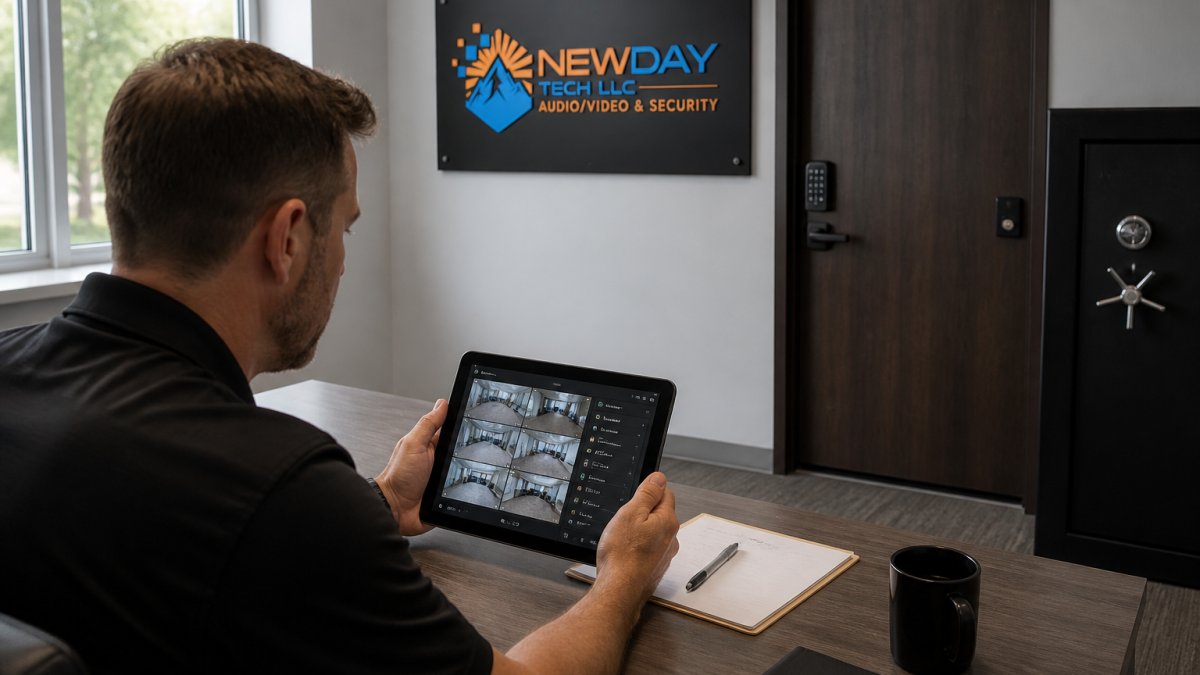
A practical example: a ranch property with 200 acres needs security coverage across barns, entry points, and remote structures. A multi-vendor approach might install IP cameras from one company and Wi-Fi from another.
With integrated design, the Wi-Fi infrastructure is built to support camera bandwidth from the start. Access points are positioned to cover camera locations. The system prioritizes security traffic during high-load periods.
Integrated security and Wi-Fi systems also simplify remote monitoring. Instead of logging into separate apps for camera feeds and network status, you see everything through one interface.
For properties in areas with spotty cellular coverage, integrated systems become critical. Your security monitoring app needs reliable connectivity to receive alerts and stream live video.
Understanding Vendor Lock-In Risks
Vendor lock-in is real, and it deserves honest consideration. When you consolidate with a single vendor, you create dependency. If the relationship sours, switching becomes expensive and disruptive. Understanding this risk helps you mitigate it.
Vendor lock-in typically manifests in three ways: proprietary integration that makes it hard to add other vendors' equipment, custom configuration that only the original vendor understands, and contractual terms that penalize early exit.
Legitimate vendor lock-in concerns exist. If a vendor uses proprietary protocols instead of industry standards, replacing their equipment later becomes difficult. If they customize your system so heavily that documentation is sparse, the next vendor faces a steep learning curve.
However, some "lock-in" is actually just the cost of integration. When a vendor designs your entire system to work cohesively, that design has value. You can't easily replace one component without losing some of that integration benefit.
Mitigate vendor lock-in risk by asking clear questions before committing. Does the vendor use industry-standard protocols and APIs, or proprietary ones? Can they provide detailed documentation of your system configuration?
A reputable vendor should be transparent about these questions. They should document your system thoroughly, use standards where practical, and make it reasonably possible to integrate other vendors' equipment in the future.
When Single Vendor Integration Makes Sense
Single vendor tech integration isn't universally optimal. It works best in specific situations; in others, multi-vendor approaches make more sense.
Single-vendor integration is strongest when:
- Complexity is high. If your property needs security, Wi-Fi, audio/video, remote monitoring, and possibly Starlink connectivity all working together, managing that complexity through one vendor eliminates coordination burden.
- Your property is rural or remote. In areas where connectivity is already challenging, having one vendor responsible for the entire infrastructure, including outdoor Wi-Fi reach, Starlink optimization, and backup systems, matters more than in urban areas where options are abundant.
- You need reliability and uptime. If your property's security, business operations, or quality of life depends on systems staying online, having one vendor accountable for system-wide reliability is valuable.
- You lack in-house IT expertise. If you don't have IT staff to manage vendor relationships and troubleshoot integration issues, single-vendor simplification is worth the trade-off.
- Support responsiveness is critical. If you need fast response times and can't tolerate the back-and-forth of multi-vendor troubleshooting, single-vendor accountability matters.
Multi-vendor approaches make more sense when:
- You have specific best-in-class requirements. If you absolutely need a particular vendor's solution for a critical function and that vendor doesn't excel at other components, multi-vendor is justified despite coordination costs.
- You have in-house technical expertise. If you have IT staff who can manage vendor relationships and handle integration, you can extract value from best-of-breed tools.
- Your needs are simple and isolated. If you just need reliable Wi-Fi and don't need tight integration with security or other systems, a single Wi-Fi vendor plus basic security might be simpler than over-integrating.
- You prioritize vendor optionality. If you want maximum flexibility to switch vendors or add new capabilities without disruption, multi-vendor architectures preserve that optionality despite higher operational cost.
For most properties in North Texas, especially rural ranches, churches, and small businesses, single-vendor integration delivers more value than the flexibility of multi-vendor approaches. The coordination burden of multi-vendor systems outweighs the theoretical advantage of best-in-class tools.
Conclusion
Single vendor tech integration simplifies how your property's technology works, who you call when problems occur, and how much time you spend managing systems instead of using them. The trade-off is accepting some vendor dependency and potentially losing the theoretical advantage of best-in-class tools from different providers.
For properties and businesses across North Texas, especially those dealing with rural connectivity challenges, security requirements, and the complexity of coordinating multiple systems, NewDay Tech provides comprehensive single-vendor integration that handles everything from initial design through ongoing support. We design your entire infrastructure to work together, install it as one cohesive system, and maintain it with accountability for system-wide performance. Request a consultation to discuss how integrated technology can simplify your property's infrastructure and improve reliability.
Frequently Asked Questions
What are the main benefits of single vendor tech integration?
Single vendor tech integration reduces administrative overhead by consolidating procurement, support, and troubleshooting under one point of contact. You eliminate handoffs between vendors, get faster first-call resolution, and simplify your technology stack. A single vendor also assumes accountability for system performance and compatibility, so when something fails, there's no finger-pointing. Most organizations see reduced downtime, clearer performance metrics, and lower total cost of ownership because one team manages integration and ongoing optimization.
Is it better to use one IT provider or multiple vendors?
That depends on your complexity and risk tolerance. Single vendor approaches work best when your technology needs are well-defined and your vendor has deep expertise across all your systems. Multi-vendor approaches offer redundancy and best-in-class solutions in each category, but require more coordination and can create compatibility gaps. For properties with integrated security, Wi-Fi, and audio/video systems, a single vendor eliminates integration headaches and ensures your systems talk to each other seamlessly from day one.
What are the risks of relying on one technology vendor?
Vendor lock-in is the primary risk. If your vendor raises prices, changes service quality, or goes out of business, switching costs can be high. You also lose redundancy; if one vendor fails, your entire technology ecosystem is affected. Concentration risk means you're dependent on one company's roadmap and priorities. Mitigate this by choosing vendors with clear exit strategies, open standards, and strong service agreements. Ask about data portability and avoid proprietary integrations that make migration expensive.
Can one provider actually integrate Wi-Fi, security, and audio/video systems?
Yes, but only if they have expertise in all three areas and use compatible hardware and software. True integration means your security cameras, Wi-Fi network, and audio/video systems share a common control interface, network infrastructure, and management platform. This eliminates separate apps on your phone and reduces compatibility issues. Look for vendors with experience in technology ecosystem design, not just installation. They should be able to explain how each system communicates and scale as your needs grow.